
If you have ever stood on a scale and wondered, “Is this weight actually healthy for my height?” — you are not alone. Millions of women ask themselves the same question every single day. That is exactly why using a BMI calculator for women is such a popular first step toward understanding your body and your overall health.
In this guide, you will learn everything you need to know about BMI — what it means for women specifically, how to read your results, what the different categories really tell you, and what practical steps you can take no matter where your number lands. We have also built a free, easy-to-use BMI calculator for women right at the top of this page so you can get your answer in less than a minute.
Let us get into it.
What Is BMI and Why Does It Matter for Women?
BMI stands for Body Mass Index. It is a number calculated from your height and weight that gives doctors and health professionals a quick snapshot of whether your body weight falls within a healthy range for your size.
The formula itself is simple: your weight in kilograms divided by your height in metres squared. Or, if you prefer pounds and inches, it is your weight in pounds multiplied by 703, divided by your height in inches squared. You do not need to do any maths manually — our BMI calculator for women handles all of that instantly.
Now, here is where it gets interesting for women specifically. BMI is calculated the same way for everyone, but the way it is interpreted can differ. Women naturally carry a higher percentage of body fat than men at the same BMI reading. This is completely normal — it is driven by biology, hormones, and the body’s natural design for reproduction. What this means in practice is that a woman with a BMI of 22 and a man with a BMI of 22 may have meaningfully different body compositions, even though the number looks identical.
That is why it is helpful to use a BMI calculator designed with women in mind — one that gives you category results, a healthy weight range, and tips that are relevant to your health as a woman, not just a generic number on a page.
How to Use This BMI Calculator for Women
Our free BMI calculator for women is designed to be as simple as possible. You do not need to register, download anything, or hand over your email address. Just follow these three steps:
Step 1 — Enter your age. You can type any age between 10 and 100, or tap one of the quick-pick buttons below the field.
Step 2 — Enter your height. You can choose between three formats: centimetres, total inches, or feet and inches separately. Whichever is most natural for you, the calculator handles it. If you are not sure of your exact height, there are common height chips to tap as a shortcut.
Step 3 — Enter your weight. Again, you can type your exact weight or use the quick-pick options. The calculator supports both kilograms and pounds — just switch the tab at the top to choose your preferred unit.
Hit “Calculate My BMI” and within a second you will see your BMI number, your category, where you sit on the full BMI scale, your healthy weight range for your specific height, and a set of personalised tips based on your result.
Understanding Your BMI Results – The Full BMI Chart for Women
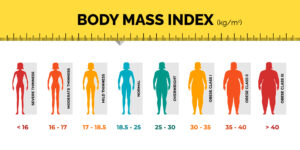
The standard BMI categories used by the World Health Organisation and leading health bodies worldwide are as follows. These apply to adult women aged 18 and over.
Underweight — BMI Below 18.5
A BMI below 18.5 is classified as underweight. This does not automatically mean something is wrong, but it is a signal worth paying attention to. Being significantly underweight can mean your body is not getting enough nutrition to function at its best. It can affect energy levels, bone density, hormonal balance, and in some cases fertility.
Women who are underweight may not have enough fat stores to support healthy menstrual cycles. If your BMI calculator result comes back below 18.5, it is worth having a conversation with your GP, especially if you have not always been in this range or if you are experiencing fatigue, frequent illness, or irregular periods.
Healthy Weight — BMI 18.5 to 24.9
This is the range that most health organisations consider optimal for adult women. A BMI between 18.5 and 24.9 is associated with the lowest risk of weight-related health conditions such as type 2 diabetes, heart disease, and joint problems.
If your BMI calculator for women result lands in this range, that is genuinely great news. It does not mean you need to do nothing — a healthy BMI does not guarantee perfect health, especially if your diet is poor or you are sedentary. But it is a solid foundation. The goal becomes maintaining it rather than changing it.
Overweight — BMI 25 to 29.9
A BMI between 25 and 29.9 places you in the overweight category. This is one of the most common results women see when they use a BMI calculator, and it is important not to panic. Being in this range does increase the statistical risk of certain health conditions, but it is also a highly actionable category. Small, consistent changes to diet and daily movement can bring BMI back into the healthy range over time without drastic measures.
Research consistently shows that losing even five to ten percent of body weight — if you are in the overweight range — can significantly reduce health risks and improve energy, sleep quality, and mood.
Obese Class I — BMI 30 to 34.9
A BMI of 30 to 34.9 is classified as Class I obesity. At this level, health risks become more significant. Conditions like high blood pressure, type 2 diabetes, sleep apnoea, and certain joint conditions are more common. However, it is worth saying clearly: obesity is a complex condition influenced by genetics, hormones, environment, mental health, medications, and many other factors. It is not simply a matter of willpower.
If your BMI result falls here, professional support is genuinely valuable — not just for motivation but because there are effective, evidence-based treatments available, from structured nutrition programmes to medical interventions, that make a real difference.
Obese Class II and Above — BMI 35 and Over
A BMI of 35 and above is classified as Class II or higher obesity. Health risks at this level are more pronounced and it becomes increasingly important to work with a healthcare team rather than attempting to manage things alone. Your GP, a registered dietitian, and possibly a specialist can build a personalised plan that addresses both the physical and psychological aspects of weight management.
BMI for Women by Age – Does Your Age Change Everything?
This is one of the most common questions women ask when using a BMI calculator, and it is a fair one. The short answer is that the standard BMI categories (18.5 to 24.9 for healthy weight) remain the same across adult age groups in most guidelines. However, age does influence how BMI is interpreted in practice.
As women get older, particularly after the age of 40 and through menopause, body composition naturally shifts. Muscle mass tends to decrease, and fat — particularly abdominal fat — tends to increase even if the number on the scale stays the same. This means that two women with identical BMI readings at ages 25 and 55 may have quite different health profiles.
Some research suggests that women over 65 may actually benefit from a slightly higher BMI — in the range of 25 to 27 — as a small amount of additional weight may be protective against bone loss and fragility. This is an area where a conversation with your doctor adds real value beyond what any online BMI calculator for women can provide.
What BMI Does Not Tell You
It is important to be honest about the limitations of BMI. It is a useful screening tool — it has been used in medicine and public health for decades for good reason — but it is not a complete picture of your health. Here is what it misses.
It does not measure body fat directly. Two women can have the same BMI but very different body compositions. A woman who trains regularly and has significant muscle mass may have a BMI in the overweight category despite being in excellent health. Conversely, a woman with a healthy BMI but very little muscle and high levels of visceral fat around the organs may face higher health risks than her BMI suggests.
It does not account for where fat is stored. Abdominal fat — fat stored around the waist and internal organs — is more strongly linked to health risks than fat stored around the hips and thighs. Waist circumference is a useful additional measure that BMI does not capture.
It may be less accurate for certain ethnic groups. Research shows that women of South Asian descent, for example, tend to carry health risks at lower BMI thresholds than white women. Many health organisations now recommend lower cutoff points for Asian populations.
None of this means BMI is useless. It means it is most helpful as a starting point — one data point among several that can help you and your healthcare provider understand your health.
Healthy BMI for Women – Practical Tips to Reach and Maintain It
Whether your BMI calculator for women result came back too high, too low, or right in the middle, there are always practical steps you can take to support your health. Here are some that are backed by evidence and genuinely work for women.
Focus on Consistency, Not Perfection
The biggest mistake most women make when they see a BMI result they are not happy with is reaching for extreme solutions — crash diets, intense exercise programmes, or dramatic lifestyle overhauls that are impossible to maintain. Research in behavioural nutrition consistently shows that small, sustainable changes outperform big, short-lived ones every time.
A 15-minute evening walk is more valuable than one punishing gym session per month. Swapping white bread for wholegrain most of the time is more valuable than eliminating entire food groups for a week. Sustainability is the strategy.
Prioritise Protein at Every Meal
Protein is particularly important for women trying to reach or maintain a healthy BMI. It supports muscle mass — which naturally declines with age — keeps you fuller for longer, and has a higher thermic effect than carbohydrates or fat, meaning your body burns more calories processing it. Aim to include a quality protein source at every meal: eggs, chicken, fish, lentils, Greek yoghurt, tofu, or cottage cheese are all excellent options.
Strength Training Is Not Optional
Many women still shy away from resistance exercise, worrying it will make them look bulky. The reality is the opposite. Strength training preserves and builds lean muscle, boosts metabolism, supports bone density (critical for women as they age), and has been shown to reduce the risk of a long list of chronic diseases. Even two 30-minute strength sessions per week make a measurable difference to body composition and BMI over time.
Sleep Is a Weight Management Tool
This one surprises a lot of women. Poor sleep directly disrupts hunger hormones — specifically ghrelin (which makes you hungry) and leptin (which tells you when you are full). Studies show that people who regularly sleep less than seven hours eat significantly more calories the following day without realising it. Protecting your sleep is not a luxury — when it comes to reaching a healthy BMI, it is part of the strategy.
Manage Stress Mindfully
Chronic stress raises cortisol levels. Chronically elevated cortisol drives fat storage around the abdomen, increases cravings for high-sugar and high-fat foods, disrupts sleep, and makes exercise feel harder. For women juggling work, family, and everything else, stress management is not a nice-to-have — it is a health essential. Whether that is mindfulness meditation, time in nature, journalling, yoga, or simply carving out twenty minutes of quiet a day, finding what works for you is worth the effort.
Frequently Asked Questions About BMI for Women
Is the BMI formula different for women and men?
No. The mathematical formula is the same — weight divided by height squared. However, because women naturally have a higher body fat percentage at equivalent BMI scores, some clinicians interpret the results slightly differently. A specialised BMI calculator for women like ours presents results with this context in mind.
What is a healthy BMI for a woman aged 30?
For a 30-year-old woman, a healthy BMI is generally between 18.5 and 24.9. This is consistent with the WHO standard healthy weight range. Individual factors like muscle mass, ethnicity, and overall health history may influence how this is interpreted by your doctor.
Can I have a healthy BMI but still be unhealthy?
Yes. This is sometimes called “normal weight obesity” — a condition where BMI is within the healthy range but body fat percentage is high and muscle mass is low. Measures like waist circumference, waist-to-hip ratio, and body fat percentage provide a more complete picture.
What is the ideal BMI for weight loss in women?
Rather than targeting a specific ideal BMI, it is more helpful to aim for a direction of travel. If your current BMI is in the overweight or obese range, even modest weight loss — enough to bring BMI down by one or two points — produces measurable health improvements. Your target does not need to be the middle of the healthy range immediately. Every step in the right direction counts.
Is BMI accurate for older women?
BMI becomes less precise as a standalone measure for women over 60 because of age-related changes in muscle mass and bone density. Many older women are advised to maintain a BMI in the range of 24 to 27 rather than the lower end of the healthy range to protect bone health and reduce the risk of frailty.
Final Thoughts – Use Your BMI as a Starting Point, Not a Verdict
A BMI calculator for women is one of the most useful free health tools available. It takes thirty seconds to use and can give you genuinely valuable information about where your weight sits relative to your height. But it is a starting point — not a verdict, not a definition of your worth, and not the whole story of your health.
Use your result as a prompt. If it falls outside the healthy range, let it motivate you to make one or two small changes this week. If it falls within the healthy range, let it reassure you and encourage you to keep doing what you are doing. If you have concerns about your weight or overall health, your GP is always the right person to speak to.
Your health is a journey, not a single number. And you are already a step ahead simply by taking the time to understand it better.