
Most of us have stood on a scale and felt either relief or disappointment depending on the number staring back at us. But here is the truth that most people do not realise: your weight alone tells you very little about your actual health. What matters far more is what that weight is made of — specifically, how much of your body is fat versus lean tissue. That is exactly what a body fat percentage calculator measures, and it is one of the most useful health tools available to both men and women today.
Whether you are on a fitness journey, trying to understand your health numbers more deeply, or simply curious about where you stand, this guide will walk you through everything you need to know — what body fat percentage is, why it matters more than weight or BMI alone, what the healthy ranges look like for men and women at different ages, and how to actually move your number in the right direction.
Our free body fat percentage calculator is right here on this page. It offers three clinically validated calculation methods, adjusts for both male and female physiology, and gives you personalised results in seconds.
What Is Body Fat Percentage?
Body fat percentage is the proportion of your total body weight that consists of fat tissue. The rest — your muscles, bones, organs, water, and everything else — is referred to as lean mass or fat-free mass.
For example, if you weigh 70 kg and your body fat percentage is 25%, that means 17.5 kg of your body is fat tissue and 52.5 kg is lean mass. That breakdown tells you something important that your weight on its own simply cannot.
Unlike body weight, which fluctuates constantly with water, food, and time of day, body fat percentage gives you a more stable and meaningful snapshot of your body composition. It is the difference between knowing how heavy you are and knowing what you are actually made of.
Why Body Fat Percentage Matters More Than Weight or BMI
You have probably heard of BMI — Body Mass Index. It is calculated from height and weight and has been used in medicine for decades. But BMI has a well-known limitation: it treats all weight the same. A professional athlete with significant muscle mass and very low body fat may register as “overweight” or even “obese” on the BMI scale, despite being in exceptional health. Meanwhile, someone with a healthy BMI but very high body fat and low muscle mass — sometimes called “skinny fat” — may face real metabolic health risks that BMI completely misses.
Body fat percentage avoids this problem entirely. It directly measures the composition of your body rather than just comparing your weight to your height. That makes it a significantly more accurate tool for assessing health risk, tracking fitness progress, and understanding whether your lifestyle changes are actually working.
This is especially important to understand when you use a body fat percentage calculator, because the results give you information that weight and BMI simply cannot.
Body Fat Percentage Chart – Healthy Ranges for Men and Women
Body fat is not the enemy — some of it is absolutely essential. The question is how much is healthy for your gender and age. Here are the widely accepted category ranges used by organisations like the American Council on Exercise (ACE):
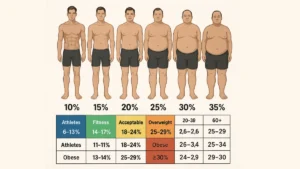
Body Fat Percentage Categories for Women
Essential fat — Under 14 percent. This is the minimum fat required for basic biological and physiological function in women. Below this level, hormonal health, bone density, and reproductive function can all be negatively affected.
Athletic — 14 to 20 percent. This range is typical of women who train seriously and maintain disciplined nutrition. The body looks lean and defined, with visible muscle tone.
Fitness — 21 to 24 percent. An excellent, sustainable range for most women. Above the athletic bracket but still well within what is considered fit and healthy. Most active women naturally land here.
Average — 25 to 31 percent. The most common range for adult women. Health risks are moderate at this level, and targeted lifestyle changes can bring body fat down meaningfully over time.
Above Average — 32 to 38 percent. Health risks begin to increase more notably here, including insulin resistance and cardiovascular strain. This is an important range to act on.
Obese — 39 percent and above. Significantly elevated health risks. Professional medical support alongside lifestyle changes is strongly recommended.
Body Fat Percentage Categories for Men
Essential fat — Under 6 percent. The absolute minimum for male physiology. Common in elite athletes during competition periods but difficult and unhealthy to maintain long-term.
Athletic — 6 to 13 percent. Typical of men who train regularly with structured nutrition. This is the range associated with visible muscle definition and high physical performance.
Fitness — 14 to 17 percent. A healthy, toned physique with good muscle visibility. Very sustainable and associated with excellent health markers.
Average — 18 to 24 percent. The most common range for adult men. Moderate health risk, manageable with consistent lifestyle improvements.
Above Average — 25 to 31 percent. Risk of metabolic conditions increases at this level. Visceral fat (fat stored around the organs) tends to accumulate in this range.
Obese — 32 percent and above. High health risk. Clinical support alongside nutritional and exercise interventions is most effective here.
How Does Age Affect Body Fat Percentage?
This is one of the most important nuances in understanding your body fat percentage calculator results — and one of the most commonly overlooked.
As we get older, body composition naturally shifts. Muscle mass begins to decline gradually from around age 30 onwards, a process called sarcopenia. Even if your body weight stays the same across the decades, the proportion that is fat tends to increase as muscle is quietly lost. This means a body fat percentage that would be considered “average” in a 25-year-old may be perfectly normal for a 50-year-old.
For this reason, the healthy body fat ranges shift slightly upward with age. A woman in her twenties aiming for the fitness range would target 21 to 24 percent. A woman in her fifties hitting 25 to 28 percent may actually be in excellent health for her age. The same principle applies to men — the goalposts shift gradually upward, and comparing your body fat percentage to a 25-year-old bodybuilder in their fifties is neither useful nor fair.
Our body fat percentage calculator asks for your age and adjusts the healthy target range it shows you accordingly. This makes the results far more meaningful and realistic than a one-size-fits-all chart.
The Three Methods Used in This Body Fat Percentage Calculator
One of the things that makes this tool different from a basic online calculator is that it offers three distinct calculation methods — each with different levels of accuracy and different equipment requirements.
1. US Navy Circumference Method
The Navy method uses measurements of your waist, neck, and (for women) hips alongside your height to estimate body fat percentage. It was developed by the United States Navy and has been validated extensively across large populations. For women, the formula is: 163.205 multiplied by the log of waist plus hip minus neck, minus 97.684 multiplied by the log of height, minus 78.387. For men, it uses the waist and neck without the hip measurement.
The Navy method requires nothing more than a flexible tape measure and is one of the most accurate non-invasive body fat estimation methods available, with an error margin of approximately plus or minus 3 percent. If you want the most reliable estimate without calipers or laboratory equipment, this is the method to use.
2. BMI-Based Estimation (Deurenberg Formula)
The Deurenberg formula uses your age, sex, and BMI to estimate body fat percentage. It is a quick and accessible option that requires only your height and weight — no tape measure needed. The formula is: body fat percentage equals 1.20 multiplied by BMI, plus 0.23 multiplied by age, minus 10.8 multiplied by sex factor (1 for male, 0 for female), minus 5.4.
The trade-off is accuracy. The BMI-based method carries an error margin of approximately 4 to 5 percent, which means it is better used as a rough guide rather than a precise measurement. If you want a quick number without measuring yourself, this method works well. For greater precision, the Navy or Skinfold method is more reliable.
3. Jackson-Pollock 3-Site Skinfold Method
The skinfold method uses body fat calipers to measure the thickness of skin folds at three specific sites on the body. For women, the sites are the tricep (back of the upper arm), the suprailiac (just above the hip bone), and the thigh. For men, the sites are the chest, the abdomen, and the thigh.
These measurements are fed into the Jackson-Pollock formula, which calculates body density and then converts that to a body fat percentage using the Siri equation. When measurements are taken correctly, the skinfold method is the most accurate of the three options offered here, with an error margin of approximately 2 to 3 percent. It requires inexpensive body fat calipers, which are widely available online.