
Understanding your body shape is one of the most practically useful things you can do when it comes to dressing well. It is not about conforming to a beauty standard or comparing yourself to anyone else — it is simply about understanding the relationship between your measurements and how different clothing silhouettes interact with your proportions. That knowledge transforms shopping from guesswork into intention.
Our free body shape calculator does the maths for you. Enter your shoulder, bust, waist, and hip measurements, and the tool instantly classifies your body type into one of five universally recognised categories, shows you exactly where your measurements sit relative to each other, and gives you specific, actionable style tips tailored to your result.
There are no good or bad shapes here. Every body type has silhouettes that look exceptional on it, and every shape has its own unique styling strengths. Let us help you find yours.
What Is a Body Shape Calculator and How Does It Work?
A body shape calculator uses the proportional relationships between four key measurements — shoulders, bust, waist, and hips — to classify your body into one of the five main recognised body shape categories. Unlike dress size or weight, which tell you nothing about your proportions, body shape describes the relationship between your widths at different points on the body.
The calculation is driven by a series of ratios. The waist-to-hip ratio tells you how defined your waist is relative to your hips. The bust-to-hip ratio tells you whether your upper and lower body are balanced. The shoulder-to-hip ratio tells you whether your upper body is broader or narrower than your lower body.
By combining these ratios with specific thresholds validated across fashion and body composition research, our body shape calculator produces a result that reflects the visual proportions of your figure — giving you a meaningful starting point for styling decisions.
The Five Body Shape Types Explained
Hourglass Body Shape
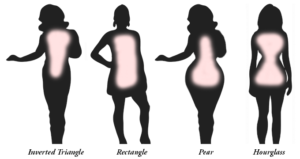
The hourglass is defined by a balanced relationship between the bust and hips — typically within five percent of each other — combined with a noticeably narrower waist. The shoulders are generally aligned with the hips, creating a symmetrical upper and lower body with a clear waist indentation.
This is often described as the most classically proportionate figure, but that does not make other shapes less beautiful or more difficult to dress. Hourglass figures have the advantage that most silhouettes work naturally, but the best results come from clothing that genuinely shows the waist rather than hiding it — wrap dresses, belted coats, fitted blazers, and bodycon styles all work exceptionally well.
If your body shape calculator result is hourglass, your styling goal is to honour the waist definition you naturally have. Avoid boxy, oversized clothing that conceals it.
Pear Body Shape
The pear shape — sometimes called triangle — is one of the most common female body types. It is characterised by hips that are noticeably wider than the bust and shoulders, with a relatively slim upper body and a defined waist. Weight tends to be carried in the hips, thighs, and lower body.
Pear shapes are beautifully proportioned and have a strong, feminine silhouette. Styling for this shape traditionally focuses on visual balance — drawing attention to the upper body to counterbalance the fuller lower half. Bold necklines, statement sleeves, and bright or patterned tops paired with plain, dark-coloured bottoms create an elegant, balanced silhouette.
A-line and fit-and-flare skirts are perennially flattering for pear shapes because they skim over the hips without adding volume. Avoid heavy embellishments, pockets, or bold prints at the hip and thigh.
Apple Body Shape
The apple shape is characterised by a broader upper body and midsection relative to the hips. The waist is less defined, and weight tends to accumulate around the middle, while the legs, arms, and hips are often slimmer. The shoulders may be broad and the bust full.
Apple shapes often have excellent legs and slimmer lower bodies — a styling asset worth emphasising. The classic approach is to create a defined waist through silhouette rather than fabric cling. Empire-waist styles, wrap dresses, V-necklines, and flowy tops that skim over the midsection all create a streamlined, elegant look.
The key principle for apple shapes is elongation and flow rather than clinging or restriction at the midsection. Long pendants, V-necks, and vertical patterns all lengthen the torso visually.
Rectangle Body Shape
The rectangle shape — also called straight, banana, or athletic — is characterised by measurements that are similar across the shoulders, bust, waist, and hips, with minimal waist definition. This shape tends to look streamlined and athletic, and is very common among naturally slim or tall women.
The styling approach for rectangles focuses on creating the appearance of curves where the body is naturally straight. Peplum tops, ruffled skirts, wide belts at the natural waist, and layered outfits all add dimension and visual interest. Because this shape is balanced and proportionate, it handles bold trends, patterns, and experimental silhouettes particularly well.
Inverted Triangle Body Shape
The inverted triangle is characterised by shoulders and bust that are clearly broader than the hips, giving the upper body an athletic or powerful appearance. The waist may be somewhat defined, but the hips are narrower than the shoulders. This shape is common in women who swim, row, or do upper-body-dominant sports.
The styling goal for inverted triangles is to add visual volume to the lower body to create balance with the broader upper half. Wide-leg trousers, A-line and full skirts, and embellished or patterned bottoms all help achieve this. Simultaneously, necklines that narrow the visual width of the shoulders — V-necks, scoop necks, deep U-necks — soften the upper body. Avoid boat necks, halter necks, and heavy shoulder padding.
How to Take Accurate Body Measurements for the Calculator
The accuracy of your body shape calculator result depends entirely on the accuracy of your measurements. Here is exactly how to measure each of the four key points.
How to Measure Your Shoulders
Stand naturally in front of a mirror or have someone assist you. Place the tape measure at the tip of one shoulder — the outermost bony point — and bring it across the back of the shoulders to the tip of the other. Do not pull the tape too tightly. The measurement should lie flat across the widest point of your shoulder line. This is your shoulder width.
How to Measure Your Bust or Chest
Wear a well-fitting, unpadded bra or measure without one. Bring the tape measure around the fullest part of your chest — typically across the nipple line — keeping it parallel to the floor. The tape should sit snugly without digging in. Take a normal breath and measure at the end of the exhale for consistency.
How to Measure Your Waist
Find the narrowest point of your torso — usually an inch or two above the navel, not at the hip bone. Exhale naturally and measure at the end of the breath. Do not suck in deliberately or hold the tape loosely — both will skew the result. The tape should lie flat against the skin with just enough room to slip a finger underneath.
How to Measure Your Hips
Stand with your feet together. Bring the tape measure around the widest point of your hips and buttocks — this is usually around eight to ten inches below your natural waist. Keep the tape parallel to the floor and ensure it passes over the fullest part of each buttock. This is your hip measurement.
All measurements should be taken in the same unit — either all in centimetres or all in inches. Our body shape calculator supports both.
Body Shape Ratios – What the Numbers Mean
Our body shape calculator displays three key ratios alongside your shape result. Understanding them adds useful context to your result.
The waist-to-hip ratio (WHR) is the most clinically significant of the three. A WHR below 0.80 in women is associated with a healthy metabolic profile. It tells you how much narrower your waist is relative to your hips — a lower number indicates more waist definition. Hourglass and Pear shapes typically have the lowest WHR values.
The waist-to-bust ratio (WBR) indicates how defined your waist is relative to your chest. A WBR below 0.75 suggests a clearly defined waist. Lower values are associated with Hourglass shapes; higher values with Apple and Rectangle shapes.
The bust-to-hip ratio (BHR) shows the balance between your upper and lower body. A BHR close to 1.0 indicates balanced upper and lower proportions, typical of Hourglass shapes. A BHR well below 1.0 indicates a Pear shape; a BHR above 1.05 often indicates an Inverted Triangle.
Body Shape and Styling – The Core Principles
Whether or not you have your body shape calculator result in hand, all flattering dressing comes down to a handful of core principles that work across every body type.
Balance is the foundation. Most styling guidance for specific body shapes is ultimately about creating the visual impression of balanced proportions — a similar width across the shoulders, bust, waist, and hips. This does not mean disguising your actual shape — it means using clothing structure, colour, and pattern to direct the viewer’s eye.
Fit matters more than size. A size-10 dress that fits perfectly will always look better than a size-8 that is too tight across the hips or a size-12 that swamps the waist. Buying clothes that fit your largest measurement and tailoring where needed is almost always the right call.
Colour and pattern obey the same physics as everything else. Darker colours and smaller patterns recede visually; brighter colours, larger patterns, and lighter shades advance. You can use this to de-emphasise or highlight any area of your body intentionally.
Fabric weight and structure shape your silhouette. Stiff, structured fabrics hold their shape away from the body — useful for Pear shapes wanting to add volume above the waist. Draped, flowy fabrics fall away from the body — useful for Apple shapes wanting to skim the midsection without clinging.
Frequently Asked Questions
Can men use a body shape calculator?
Yes, though the five categories used in this calculator — Hourglass, Pear, Apple, Rectangle, and Inverted Triangle — were developed for female body proportions and are most commonly applied to women’s fashion. Men’s body shape analysis typically uses different categories (trapezoid, oval, rectangle, triangle, and inverted triangle) with different measurement points. This calculator is primarily designed for women’s measurements and style guidance.
What if I am between two body shapes?
Body shape is a spectrum, not a rigid category. Many people sit on the boundary between two types — for example, between Hourglass and Pear if the hips are slightly wider than the bust with a defined waist. In these cases, read the style tips for both shapes and apply whichever feel most relevant to your figure. Your body shape calculator result is a useful starting point, not an absolute definition.
Does body shape change with weight?
Yes, though usually gradually. Weight gain tends to be distributed in pattern that is characteristic of your underlying shape — Pear shapes gain in the hips and thighs, Apple shapes gain in the midsection, and so on. Significant weight change can shift you between adjacent categories. It is worth recalculating your body shape if your measurements have changed by more than five centimetres in any area.
Can I change my body shape?
Your bone structure — which determines the width of your shoulders, hips, and ribcage — is fixed. What changes with diet and exercise is the amount of muscle and fat tissue distributed around that structure. Building muscle selectively can alter perceived proportions to some degree — for example, building shoulder and back width can make an hourglass shape more defined. But the underlying skeletal framework, which largely drives body shape classification, remains constant.
Is the hourglass shape the most attractive?
Body attractiveness is subjective, cultural, and entirely personal. The hourglass is historically associated with a culturally specific beauty ideal in certain Western contexts, but this varies enormously across cultures and eras. Research on body shape and attractiveness consistently shows that confidence, health, and how well clothing fits are far more significant factors than conforming to any particular shape. Every body type in our calculator has genuine styling strengths and a wealth of flattering options.
Final Thoughts – Your Body Shape Is a Styling Tool, Not a Verdict
A body shape calculator is exactly what the name says — a calculator. It takes your measurements and uses established proportional ratios to give you a useful classification for styling purposes. That is all it is. It is not a measure of beauty, health, or worth, and it is not a box you are confined to.
Use the result practically. Let it guide you toward silhouettes that work well with your proportions. Experiment with the style tips, and keep the ones that make you feel good while ignoring the ones that do not. Fashion has no laws, only suggestions.
The most consistently flattering thing any person can wear is clothing that fits well, suits the occasion, and is worn with confidence. Your body shape result is a shortcut to finding more of those pieces, faster.