
Ask ten people how much protein they eat and you will likely find two groups: those who eat far too little and have no idea, and those who obsess over protein shakes and believe more is always better. Neither approach is optimal. Your actual daily protein requirement is a specific number — shaped by your body weight, your body composition, your age, your activity level, and your goal — and getting it right makes a measurable difference to how your body looks, performs, and recovers.
A protein intake calculator removes the guesswork. Use the free tool above to get your personalised protein target in under a minute, then read on to understand what the science actually says about why protein matters, how much you genuinely need, and how to hit your target consistently every day.
What Is Protein and Why Does It Matter So Much?
Protein is one of the three macronutrients alongside carbohydrates and fat, but it plays a fundamentally different role in the body. Where carbohydrates and fat primarily serve as fuel sources, protein is the structural material of life. It makes up your muscle tissue, your skin, your hair, your enzymes, your hormones, and your immune system components. Every single cell in your body depends on protein to function.
From a body composition standpoint, protein has three properties that make it uniquely important compared to the other macronutrients.
First, protein is the only macronutrient that directly builds and repairs muscle tissue. The process of muscle protein synthesis — the biological mechanism by which your body creates new muscle fibres in response to exercise — is driven by the availability of amino acids, which come exclusively from dietary protein. Without adequate protein, muscle growth is impossible, and muscle preservation during weight loss is severely compromised.
Second, protein is the most satiating macronutrient. Research consistently shows that high-protein meals reduce hunger hormones more effectively than equivalent-calorie meals from carbohydrates or fat. Studies published in the American Journal of Clinical Nutrition found that increasing protein intake from 15 to 30 percent of total calories caused participants to spontaneously eat around 441 fewer calories per day — without any other dietary instruction.
Third, protein has the highest thermic effect of food of any macronutrient. Between 25 and 35 percent of the calories in protein are burned during the digestion and processing of protein itself, compared to five to ten percent for carbohydrates and two to three percent for fat. This means a portion of your protein calories are essentially spent in the act of eating them.
Understanding these three properties is why a protein intake calculator is one of the most valuable free tools available for anyone focused on body composition, whether the goal is fat loss, muscle gain, or both.
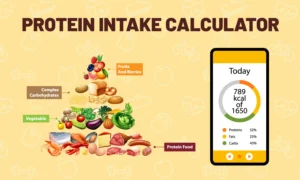
How Much Protein Do You Actually Need? The Evidence Explained
The official Recommended Dietary Allowance for protein is 0.8 grams per kilogram of body weight per day. This figure is widely cited — and almost universally misunderstood. The RDA represents the minimum protein intake required to prevent deficiency in sedentary adults. It was never intended to represent the optimal intake for active individuals seeking body composition improvements, and it falls significantly short of what research actually recommends for almost everyone who exercises.
A landmark meta-analysis published in the British Journal of Sports Medicine by Morton and colleagues, which pooled data from 49 separate studies involving over 1,800 participants, found that protein intakes up to 1.62 grams per kilogram of body weight per day significantly increased muscle mass gained from resistance training. Beyond this threshold, additional protein produced diminishing returns for muscle growth in most people.
However, other research has found meaningful benefits at higher intakes in specific contexts — particularly during calorie restriction, where protein requirements increase substantially to prevent muscle loss. Our protein intake calculator accounts for all of these contexts and adjusts your recommendation based on your individual goal.
Protein Requirements by Goal – What Our Calculator Uses
Protein Intake for Weight Loss
During a calorie deficit, your body faces a challenge: it needs energy and will obtain it from stored fat, but it will also break down muscle tissue if dietary protein is insufficient. This process — called muscle catabolism — is one of the most damaging aspects of aggressive dieting and a primary reason why people who repeatedly crash diet end up with less muscle and a slower metabolism over time.
The solution is straightforward: eat more protein during a deficit, not less. Research from the International Society of Sports Nutrition recommends 1.6 to 2.4 grams of protein per kilogram of body weight during energy restriction, with the higher end of the range being appropriate for individuals who train intensively or are in a large calorie deficit. This higher intake simultaneously preserves muscle, increases satiety, and supports fat loss — making it the single most important nutritional lever during any weight loss phase.
Protein Intake for Muscle Building
Building muscle requires both a calorie surplus and adequate protein. The current evidence-based consensus from the International Society of Sports Nutrition places the optimal protein intake for muscle gain between 1.6 and 2.2 grams per kilogram of body weight per day for natural trainees. Most large-scale studies find that intakes beyond 2.2 grams per kilogram produce minimal additional muscle gain — the extra protein is simply oxidised as fuel.
One important nuance is the distinction between total body weight and lean body mass. For individuals who carry significant body fat, basing protein targets on total weight can overestimate needs, while basing them on lean body mass is more precise. Our protein intake calculator allows you to enter your body fat percentage to enable this more accurate calculation.
Protein Intake for Maintenance
If your weight and body composition are where you want them and your goal is simply to maintain, your protein needs are lower but still meaningfully above the RDA minimum. The ISSN recommends a range of 1.4 to 1.8 grams per kilogram of body weight for active adults in maintenance, with activity level being the primary modifier. Sedentary adults require less — closer to 1.0 to 1.2 grams per kilogram — while those training regularly need the higher end of the range.
Protein Intake for Athletes
Endurance and sport athletes have distinct protein needs compared to the recreational gym-goer. In endurance sports, protein is used to repair muscle damage from sustained activity and to support the adaptation of connective tissue. The American College of Sports Medicine recommends 1.2 to 2.0 grams per kilogram per day for endurance athletes, with the higher end appropriate during heavy training blocks.
Protein Intake for Adults Over 55
One of the most under-discussed areas of protein science is the increased requirement for older adults. After approximately the age of fifty-five, a phenomenon called anabolic resistance begins to take effect — the body becomes less efficient at using dietary protein to stimulate muscle protein synthesis. The practical consequence is that older adults need more protein per kilogram of body weight than younger adults to achieve the same muscle-preserving effect.
Research published in the Journal of Nutrition recommends at least 1.0 to 1.2 grams per kilogram of body weight per day for healthy older adults, rising to 1.2 to 1.6 grams for those who are physically active. The European Society for Clinical Nutrition recommends 1.0 to 1.2 grams even for sedentary older adults, with 1.2 to 1.5 grams for those with chronic illness or injury.
Protein Intake for Plant-Based Diets
Vegetarians and vegans need to pay special attention to protein because most plant protein sources are incomplete — meaning they lack one or more essential amino acids — and generally have lower bioavailability than animal proteins. The digestibility-corrected amino acid score for most plant proteins is lower than for whey, egg, or meat proteins, which means a larger quantity is needed to deliver the equivalent anabolic stimulus.
Our protein intake calculator applies a bioavailability adjustment for plant-based goals, typically recommending ten to twenty-five percent higher protein intake than the equivalent goal for omnivores. Combining different plant protein sources throughout the day — legumes with grains, for example — creates a complete amino acid profile that more closely mirrors animal protein.
The Importance of Protein Distribution — Timing and Meal Structure
Total daily protein matters most, but how you distribute it across the day also influences outcomes — particularly for muscle building. The concept of muscle protein synthesis is important here. Each meal containing sufficient protein triggers a wave of muscle protein synthesis that peaks at around two to four hours and then subsides. To maximise total daily synthesis, the goal is to trigger multiple waves across the day by distributing protein evenly across meals.
Research from Dr. Stuart Phillips at McMaster University has consistently found that distributing protein intake evenly across three to four meals — each providing 25 to 40 grams — produces greater muscle protein synthesis over 24 hours than the same total protein skewed toward one or two large meals.
Our protein intake calculator generates a personalised per-meal breakdown based on your daily total and your preferred number of meals per day, making it practical to hit both your daily target and the optimal per-meal dose.
How to Use This Protein Intake Calculator
Step one — Select your biological sex. Protein recommendations are adjusted for the physiological differences between male and female metabolism and body composition.
Step two — Choose your unit system and enter your weight. Weight is the primary driver of your protein target. Use your current body weight, not your goal weight.
Step three — Enter your height. Height is used for BMI estimation and reference calculations within the tool.
Step four — Enter your body fat percentage (optional). If you know your body fat percentage from our body fat calculator or another reliable source, entering it enables the calculator to base your protein target on lean body mass rather than total weight — which is more accurate, particularly for individuals with higher body fat percentages.
Step five — Set your age using the slider. The calculator automatically adjusts protein recommendations for adults over 55 to account for anabolic resistance.
Step six — Select your activity level. This is a key modifier — protein needs scale meaningfully with exercise frequency and intensity.
Step seven — Choose your meals per day. This generates your per-meal protein target, which is as important as the daily total for maximising muscle protein synthesis.
Step eight — Select your goal. Choose from six goal categories: Lose Fat, Maintain, Build Muscle, Athlete, Healthy Ageing, or Plant-Based. Each uses a specific evidence-based protein factor range calibrated to the research literature.
Hit Calculate — your personalised daily protein target, per-kg values, per-meal schedule, food source guide, and tailored tips appear instantly.
Best Protein Food Sources to Hit Your Daily Target
Knowing your protein target is one thing — building a diet that hits it consistently is another. Here are the most efficient protein sources available.
For animal-based protein: chicken breast provides approximately 31 grams per 100 grams, making it one of the leanest and most cost-effective sources available. Canned tuna delivers 26 grams per 100 grams with virtually no fat and exceptional convenience. Eggs provide 13 grams per 100 grams with a near-perfect amino acid profile and the highest biological value of any whole food. Greek yoghurt delivers around 10 grams per 100 grams alongside beneficial probiotics and calcium.
For plant-based protein: tempeh provides 19 grams per 100 grams and is one of the most bioavailable plant proteins. Edamame delivers 11 grams per 100 grams with a complete amino acid profile. Firm tofu provides 8 to 17 grams per 100 grams depending on the variety. Lentils offer 9 grams per 100 grams alongside significant fibre and iron.
Whey protein powder remains the most efficient supplement option, with approximately 24 grams of high-bioavailability protein per scoop at minimal calorie cost. Our calculator’s food source guide is personalised to your goal — plant-based options are prioritised for users who select the plant-based goal.
Frequently Asked Questions
Can you eat too much protein?
For healthy adults with normal kidney function, high protein intakes — even those significantly above the RDA — have not been shown to cause harm in multiple long-term studies. The concern about protein and kidney damage relates primarily to people with pre-existing kidney disease, for whom high protein intake can worsen existing damage. For healthy individuals, protein intakes up to 3.5 grams per kilogram of body weight have been used in research settings without adverse effects.
Does protein make women bulky?
No. This is one of the most persistent misconceptions in fitness nutrition. Building significant muscle mass requires years of consistent resistance training and, for women, is naturally limited by lower testosterone levels. High protein intake without the specific training stimulus and calorie surplus required for hypertrophy will not cause unwanted muscle bulk. In fact, high protein intake during a calorie deficit tends to produce a leaner, more toned appearance — which is the opposite of bulky.
Is protein timing important?
Protein timing matters but ranks below total daily protein in importance. The anabolic window — the idea that protein must be consumed immediately after exercise — is far less rigid than once believed. Research now suggests that muscle protein synthesis remains elevated for up to 24 hours post-exercise, meaning total daily intake distributed across multiple meals matters more than precise timing. That said, consuming 20 to 40 grams of protein within two hours of resistance training does meaningfully support recovery and adaptation.
What is the difference between protein intake and protein absorption?
Your body can absorb essentially all of the protein you consume — absorption in the small intestine is highly efficient. The relevant limit is not absorption but muscle protein synthesis, which is optimised by doses of 25 to 40 grams per meal. Consuming 100 grams of protein in a single meal does not produce four times the anabolic response of 25 grams — the excess is oxidised or excreted. This is the scientific basis for distributing protein across multiple meals.
Should I count protein from all food sources?
Yes. Protein in your daily target comes from all dietary sources — meat, dairy, eggs, legumes, grains, vegetables, and supplements. While the bioavailability varies between sources, all dietary protein counts toward your daily total. Tracking apps like MyFitnessPal or Cronometer make accounting for all protein sources straightforward.
Final Thoughts – Make Your Protein Intake Calculator Result Work for You
Your protein intake calculator result is a personalised, evidence-based starting point grounded in decades of nutritional research. Unlike generic dietary advice, it accounts for your specific weight, body composition, age, activity level, and goal.
The most important thing you can do with your result is act on it consistently. Protein works through accumulation — the meals you hit your target in today, and tomorrow, and next week compound into measurable changes in muscle mass, body fat, and physical performance over weeks and months.
Use the per-meal breakdown from the calculator to build your daily food plan. Track your protein intake for the first two to four weeks to build awareness of what your target actually looks like in real food. Then, as it becomes habitual, you will find you no longer need to count — because your food choices will naturally cluster around your target.
Start with the number. Build the habit. Trust the process.