
For many adults, the question of whether they might have ADHD comes after years of struggling to focus, forgetting important things, feeling restless in meetings, or watching deadlines slip past despite genuine effort. It often comes after a colleague mentions they have just been diagnosed, or after reading an article that describes experiences they have felt their whole life but never had words for.
If any of that sounds familiar, this ADHD self-assessment is a useful starting point. It is a structured screening tool based on DSM-5 diagnostic criteria and the Adult ADHD Self-Report Scale. It will not give you a diagnosis — only a qualified clinician can do that — but it will help you understand your symptom patterns, put a framework around your experiences, and give you language and structure to take into a conversation with your doctor.
Use the tool above to complete your assessment, then read on to understand what ADHD really is, how it presents in adults, what the different types look like, and what the process of getting a proper assessment actually involves.
What Is ADHD? Beyond the Stereotypes
Attention Deficit Hyperactivity Disorder is one of the most common neurodevelopmental conditions in the world, affecting an estimated five to seven percent of children and two to five percent of adults globally. Despite its prevalence, ADHD remains one of the most misunderstood conditions in mental health — partly because the stereotype of a hyperactive, disruptive child bears little resemblance to how ADHD often presents in adults.
ADHD is fundamentally a disorder of executive function and self-regulation. The term attention deficit is somewhat misleading — people with ADHD do not lack the ability to pay attention. They lack the ability to consistently regulate where their attention goes, whether that means sustaining focus on demanding tasks, resisting distraction, shifting attention when needed, or starting tasks that feel overwhelming even when they are important.
The neurological basis of ADHD involves differences in dopamine and norepinephrine signalling in the prefrontal cortex — the part of the brain responsible for planning, impulse control, working memory, and the regulation of attention and behaviour. These are not character flaws or motivational failures. They are biological differences in brain chemistry that respond well to both evidence-based treatments and lifestyle strategies when properly identified.
The Three Presentations of ADHD Explained
The DSM-5 — the Diagnostic and Statistical Manual used by clinicians worldwide — recognises three distinct presentations of ADHD, each with different symptom profiles. Understanding which type may apply to you is one of the most useful things our ADHD self-assessment can do.
Predominantly Inattentive ADHD (ADHD-PI)
Formerly known as ADD, the Predominantly Inattentive presentation is characterised by significant difficulty sustaining attention, following through on tasks, and staying organised, without the prominent hyperactivity seen in other presentations.
Adults with inattentive ADHD often describe a pattern of starting tasks with good intentions and then losing the thread — not due to a lack of desire to complete them, but because attention drifts, distractions pull focus, or the sheer effort of maintaining mental engagement on one thing becomes unsustainable. They may appear perfectly calm outwardly while experiencing significant internal disorganisation.
This presentation is significantly underdiagnosed, particularly in women and girls, because the absence of disruptive behaviour means it often goes unnoticed in school and is misattributed to laziness, lack of intelligence, or anxiety. Many adults with ADHD-PI receive diagnoses only in their thirties, forties, or beyond — and often describe the experience of finally understanding why certain things have always been hard as profoundly validating.
Predominantly Hyperactive-Impulsive ADHD (ADHD-PH)
The Predominantly Hyperactive-Impulsive presentation features restlessness, impulsivity, and an internal sense of being driven by a motor, with relatively less difficulty with sustained attention. Adults with this presentation may find it hard to sit still in meetings, interrupt conversations without meaning to, make impulsive decisions they later regret, or speak before thinking.
In adults, the overt physical hyperactivity of childhood often transitions into internal restlessness — a sense of being unable to slow down, a constant urge to move or shift activities, and difficulty engaging in quiet leisure activities without fidgeting or seeking stimulation.
Combined Presentation ADHD (ADHD-C)
The Combined Presentation is the most common form of ADHD in adults. It involves significant symptoms across both the inattentive and hyperactive-impulsive domains. People with ADHD-C typically experience the full range of challenges — difficulty sustaining focus, organising tasks, controlling impulses, managing restlessness, and regulating their emotional responses. It is also the presentation most strongly associated with executive function difficulties such as time blindness, task initiation problems, and working memory challenges.
ADHD Symptoms in Adults – What They Actually Look Like Day to Day
ADHD symptoms in adults look different from the classroom behaviour associated with childhood ADHD. Here is what the most common presentations actually feel like in daily adult life.
Inattention Symptoms in Adults
Difficulty sustaining attention in adults rarely looks like staring blankly into space. It is more likely to manifest as reading the same paragraph four times without retaining it, going to get something from another room and forgetting what it was before you arrive, opening a work document and finding yourself reading something entirely unrelated twenty minutes later without any conscious decision to switch.
Forgetting appointments, losing keys, phone, and glasses regularly, and struggling to keep track of multiple responsibilities simultaneously are all hallmarks of adult inattention. So is the pattern of knowing exactly what needs to be done and being completely unable to start it — not due to procrastination in the motivational sense, but due to a neurological barrier to task initiation sometimes described as the ADHD brain’s inability to self-start without urgency, novelty, or strong personal interest.
Hyperactivity and Impulsivity Symptoms in Adults
Adult hyperactivity is less likely to involve running around a classroom and more likely to involve an inability to sit through long meetings without fidgeting, a tendency to speak quickly, finish other people’s sentences, or say things without the filter of social consideration. It manifests as the sensation of always needing to be doing something, a constant stream of thoughts that is difficult to quiet, and an internal restlessness that can make relaxing feel impossible.
Impulsivity in adults often shows up in spending decisions, relationship dynamics, or career changes — acting quickly on feelings or ideas before fully thinking through consequences.
Executive Function and Emotional Regulation
Two areas that the standard ADHD checklist often underemphasises are executive function and emotional regulation. Research increasingly recognises that ADHD is as much a disorder of emotional and executive self-regulation as it is of attention.
Time blindness — a genuine inability to perceive and manage time intuitively — is one of the most functionally disruptive aspects of ADHD for many adults. People with ADHD often describe feeling like they exist in only two time zones: now and not now. Everything beyond the immediate present is poorly calibrated, leading to chronic lateness, missed deadlines, and the exhausting pattern of leaving everything to the last possible moment.
Emotional dysregulation manifests as intense, fast-rising emotional responses that subside quickly but can cause significant damage in relationships and professional settings in the interim. A sense of rejection sensitivity — disproportionate distress in response to perceived criticism or rejection — is particularly common and significantly impacts social and professional functioning.
ADHD in Women – Why It Is Still Underdiagnosed
ADHD in women and girls deserves special mention because the gap between symptom onset and diagnosis remains significantly larger for women than for men. Research suggests that girls with ADHD are diagnosed on average five years later than boys, and many women do not receive a diagnosis until adulthood — often in their thirties or forties, sometimes prompted by a child’s diagnosis or a period of intense stress that overwhelms previously sufficient coping mechanisms.
Several factors contribute to this underdiagnosis. Girls with ADHD are more likely to present with the inattentive type, which is quieter and less disruptive — and therefore less likely to be flagged by teachers. Girls are also more likely to develop compensatory strategies that mask symptoms, such as working much harder than peers to produce equivalent academic results, or using social awareness to mask impulsive tendencies. These strategies work at significant personal cost — exhaustion, anxiety, and low self-esteem are common companions to undiagnosed ADHD in women.
Hormonal fluctuations across the menstrual cycle, pregnancy, and menopause also affect ADHD symptoms in ways that are still being researched. Many women report significant worsening of symptoms in the premenstrual phase and during perimenopause, when oestrogen levels fluctuate — oestrogen influences dopamine signalling, which directly affects ADHD symptom severity.
If you are a woman who has struggled with focus, organisation, or emotional regulation throughout your life and been told it is just anxiety or perfectionism, completing this ADHD self-assessment and discussing the results with a knowledgeable clinician may provide important clarity.
About This ADHD Self-Assessment – What It Measures and How
Our ADHD self-assessment is a structured symptom screening tool based on two validated frameworks: the DSM-5 diagnostic criteria for ADHD and the Adult ADHD Self-Report Scale (ASRS-v1.1), developed by the World Health Organisation.
The assessment covers five distinct areas across 21 questions.
The first section — inattention — addresses nine core symptoms from DSM-5 Criterion A1, including difficulty sustaining attention, making careless mistakes, failing to follow through on instructions, and being easily distracted.
The second section — hyperactivity and impulsivity — addresses nine symptoms from DSM-5 Criterion A2, including fidgeting, restlessness, talking excessively, interrupting others, and acting impulsively.
The third section — executive function and emotional regulation — covers nine additional symptoms that are clinically significant in adult ADHD but not always captured by the traditional symptom lists, including time blindness, task initiation difficulties, working memory challenges, and emotional dysregulation.
The fourth and final section — functional impact — asks three questions about how your experiences affect your performance at work, your personal relationships, and your management of daily life. This is important because DSM-5 requires evidence of impairment in at least two settings for a clinical ADHD diagnosis.
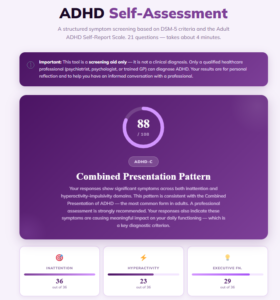
Each question is rated on a five-point scale from Never to Very Often. Your results are presented across three domain subscores and a total score, alongside a pattern classification (Unlikely, Inattentive, Hyperactive-Impulsive, or Combined) and a set of personalised next steps based on your results.
What Happens After the Assessment? Understanding the Diagnosis Process
A positive or elevated result on an ADHD self-assessment is not a diagnosis. It is a signal that your symptom pattern warrants professional evaluation. Here is what that process typically looks like.
The first step is a conversation with your GP. Bring your assessment results, a written list of specific examples of how your symptoms affect your daily life, and if possible, feedback from someone who knows you well — a partner, parent, or close friend who can describe your behaviour from an external perspective. Your GP will assess whether a referral for specialist evaluation is appropriate.
A formal ADHD assessment is typically conducted by a psychiatrist, psychologist, or ADHD specialist and involves a structured clinical interview, standardised symptom rating scales, a developmental history going back to childhood (DSM-5 requires that some symptoms were present before age twelve), and sometimes cognitive or neuropsychological testing. It may take one or more appointments and can vary in depth and approach depending on the clinician and setting.
It is also important to rule out other conditions that share symptoms with ADHD. Anxiety, depression, sleep disorders, thyroid dysfunction, and autism spectrum conditions can all produce symptoms that overlap significantly with ADHD. A good clinician will consider all of these possibilities as part of a thorough assessment.
If a diagnosis is made, treatment options include medication (stimulant and non-stimulant options), psychological therapies (particularly ADHD-focused cognitive behavioural therapy), coaching, and practical lifestyle strategies. Many people find that even before receiving a formal diagnosis, understanding that their struggles have a neurological basis rather than a character flaw produces significant relief.
Frequently Asked Questions About ADHD
Can adults be diagnosed with ADHD for the first time?
Yes — absolutely. Many adults receive their first ADHD diagnosis in their twenties, thirties, forties, or beyond. The DSM-5 requires that some symptoms were present before age twelve, but this does not mean the diagnosis must have been made in childhood. Many adults with ADHD were simply never assessed — either because their symptoms were mild enough to be masked by intelligence or compensatory strategies, or because ADHD was less widely recognised when they were growing up.
Is ADHD overdiagnosed?
This is a topic of ongoing debate in the research literature. Some studies suggest rates have risen due to increased awareness and broader diagnostic criteria. Others argue that ADHD remains significantly underdiagnosed, particularly in women, older adults, and people from minority ethnic backgrounds who have historically had less access to mental health services. The most measured position is that ADHD is simultaneously overdiagnosed in some populations (particularly young boys showing normal developmental behaviour) and underdiagnosed in others (particularly women and adults).
What is the difference between ADHD and ADD?
ADD (Attention Deficit Disorder) was the older terminology, used before 1994 to describe what is now called the Predominantly Inattentive presentation of ADHD. The DSM-4 revision combined the conditions under the ADHD umbrella with three distinct subtypes. ADD is no longer an official diagnostic category, though the term is still widely used informally to describe the inattentive presentation without significant hyperactivity.
Can anxiety cause ADHD-like symptoms?
Yes — anxiety and ADHD share several overlapping symptoms, including difficulty concentrating, restlessness, and poor sleep. This overlap frequently leads to misdiagnosis in both directions. The key distinction is the cause of the symptom: in anxiety, poor concentration is driven by worry and rumination; in ADHD, it is driven by an inability to regulate attention regardless of anxiety level. Many people have both conditions simultaneously, which is why professional evaluation is so important.
Is ADHD a disability?
In most countries, ADHD is recognised as a disability under equality and discrimination legislation when it substantially impairs major life activities. This means people with ADHD diagnoses may be entitled to reasonable accommodations in educational and workplace settings — such as extended time on exams, written instructions, or flexible working arrangements. The specific entitlements vary by country and context; a diagnosis from a qualified clinician is typically required to access formal accommodations.
Final Thoughts – Your Self-Assessment Is a Starting Point, Not an Ending
An ADHD self-assessment is one of the most useful things you can do if you have been carrying unanswered questions about your attention, focus, or behaviour for years. It gives your experiences a structure, a language, and a framework that makes it easier to seek and receive appropriate help.
But it is only the beginning. Whether your results suggest that ADHD symptoms are present or not, the most important next step is to have a conversation with a healthcare professional who can conduct a proper evaluation in the context of your full personal and medical history.
If your results are elevated, please do not self-diagnose or begin researching medication without professional guidance. ADHD is a complex condition that benefits enormously from expert support — and that support is more accessible than many people realise.
If your results are low but something still feels off, trust your instincts. This assessment covers a specific symptom set, and there are many reasons why scores might not fully reflect your experience. An honest conversation with your GP is always the right move.
You know yourself. This tool is here to help you put that knowledge into words.